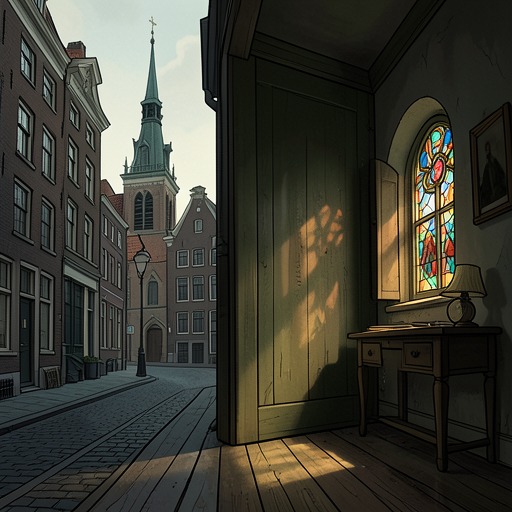
Stella visits the Begijnhof seeking a religious community
Midwinter BreakStella visits the Begijnhof seeking a religious community at a moment when the life she has organized for everyone else no longer feels sufficient for her. She hopes to discover whether a woman can live independently within a religious community without entering a convent or making permanent vows. The enquiry is both spiritual and practical: she wants a more devout life, but she is also asking whether there is still time to change the shape of her marriage and her days. The Begijnhof offers an image of sanctuary, then confronts her with the limits of age, money, and institutional change.
The Search for a Different Life
For much of her life, Stella has met difficulty by organizing around it. She chairs the residents’ association, serves as a Eucharistic minister in her parish, organizes sales, and has bought and sold flats for her son, Michael Gilmore. Gerry calls her his transport captain because she can plan a complicated journey, book hotels, contact people, and hold the whole itinerary in her mind. Those capacities make her feel that she ought to be able to stand up for herself, yet leaving Gerry initially seems almost impossible. The prospect becomes more imaginable because both sets of parents have died and Michael has made a life and family of his own in Canada. If Gerry continues drinking as he does, she would rather live elsewhere.
Her interest in the Begijnhof is not an improvised response to the Amsterdam trip. On an earlier visit to the city she heard of the place as somewhere women might live a religious life, and the idea stayed with her. Now she is tired of the way she and Gerry live and feels aimless, with no clear role left to her. She is not proposing a convent or claiming that she has already decided to leave. She is exploring the possibility of a women’s religious community, perhaps one closer to home, and trying to determine what a useful and devout life could look like in the time remaining to her.
Entering the Begijnhof
Stella makes the first visit alone, carrying an Amsterdam guide and trying to make sense of the canals, whose routes and distances confuse her. She walks past the entrance several times. At last she finds the brick archway and follows a dark passage, where her footsteps echo before she emerges into an enclosed court. The transition from passage to open space strikes her as a kind of birth: she feels briefly like a new person. Around her, old houses turn inward around a green, sheltered space, and a Christ-like statue faces a red-brick church. The passage seems to screen out the surrounding city; trains, trams, and cars give way to silence and the chirping of sparrows.
That enclosure supplies the sanctuary feeling she has come to investigate. It is not only an architectural impression: the sudden quiet and inward-facing court give physical shape to her hope of withdrawing from the noise of ordinary life without disappearing from the world. She walks around the space, taking in the winter trees and the light on their wet branches. Yet the visit also brings her back to the body and its vulnerability. She reflects on birth, death, and the fact that she once came close to death herself, while trying to keep traumatic memories of giving birth from taking hold. The court holds both possibilities at once: refuge and a reminder that a life cannot simply be begun again without its history.
When Gerry later asks what she wanted at the Begijnhof, Stella explains that she made enquiries and is due to speak with a woman who was not there during her first visit. She tells him that the place began as a home for the Beguines, women who lived in a religious sisterhood without taking permanent vows and could return to the world and marry. That history matters to her because it suggests a form of belonging that does not demand the irrevocability of convent life. She has made an appointment for Monday with the Spiritual Director, or a person in that role, and describes what she is seeking as a religious community rather than seclusion: women could have homes of their own without taking vows of poverty.
Faith as a Daily Practice
Stella’s enquiry grows out of a faith that already structures her life, even when Gerry does not see it. One night in the hotel, he catches her kneeling beside her bed in prayer. He initially thinks she has dropped something, then realizes what she is doing and holds back a joke. At home they often go to bed at different times, and he had not known that she still prayed this way. Her nightly practice moves through the people she loves—her parents and siblings as well as her family—and includes thanks for her life and her survival. She also prays for refugees, people under pressure, and those fleeing war. The repeated routine is a form of spiritual tidying, an ordinary discipline through which she attends to others and orders her thoughts.
Her public religious role is visible to Gerry in a different way. At Christmas Mass, after the congregation exchanges a sign of peace, Stella tells him that she and Sister Francis are serving as Eucharistic ministers. She goes to the altar and distributes communion from a gold chalice; Gerry watches her stoop to offer the host and sees her as someone he does not fully know. After returning to her seat, she kneels with her face in her hands and appears to be fretting. These scenes establish that her search is not a sudden turn toward religious life from outside it. She already prays, serves, and takes part in communal worship; what she is seeking is a form of life in which those practices might become the center of her days rather than one responsibility among many.
A Community and Its Limits
The answer to Stella’s enquiry is mixed. The sisterhood is real, and women can still live at the Begijnhof, but its religious character has largely disappeared. There is a long waiting list, perhaps five years or more. Applicants must be women prepared to live by themselves, between thirty and sixty-five, and able to afford the arrangement. Stella takes in the information, her face falling as she recognizes that she is too old to qualify. The place that had seemed to offer a new beginning cannot provide the particular religious community she imagined, and the age threshold makes the obstacle institutional as well as personal.
The rejection does not erase what the visit has clarified. Afterward, Stella continues to consider living on her own, even if she cannot join an organization. She imagines selling the shared tenement flat and buying two small flats, hers with a garden. At once, however, she catches herself planning Gerry’s life too—where he might live, how he would manage meals, and what he would do with his books and CDs. Her familiar care-taking impulse persists even as she tries to picture separation. The Begijnhof has brought her desire for independence into view, but it has not made that desire simple.
At the airport, when the possibility of an all-female religious collective is no longer available, Stella tells Gerry that if he keeps his word about giving up drinking, they may not need to sell the flat. The exchange leaves the future conditional rather than settled: her search has not produced a new residence, and Gerry’s promise has yet to become a life of sobriety. Still, the terms have changed. Stella has stated that she is tired of their way of living and has investigated an alternative for herself; now the question of staying together is connected to whether Gerry changes his drinking. Her visit therefore marks a turn from private longing toward practical choice, while leaving both the marriage and the next stage of her life unresolved.